Jesus said, The [Father's] imperial rule is like a woman who was carrying a [jar] full of meal. While she was walking along [a] distant road, the handle of the jar broke and the meal spilled behind her [along] the road. She didn't know it; she hadn't noticed a problem. When she reached her house, she put the jar down and discovered that it was empty. (97 Thomas)
God's domain is not what we expect.
It is as a woman, said to a culture that oppressed women.
God's domain travels distant roads.
It is as a broken vessel.
God's domain is a spilling out of life's sustenance.
It is oblivious to loss.
Monday, June 30, 2008

Sunday, June 29, 2008
Jesus [said], The Father's imperial rule is like [a] woman who took a little leaven, [hid] it in dough, and made it into large loaves of bread. Anyone here with two ears had better listen! (96 Thomas)
Two ears - and a bit of context - help us hear.
It is worth recalling that one of the most common rituals of Jewish life, both then and now, is to remove all leaven from one's possession before celebrating Passover.
This is part of recalling the need to escape Egypt so quickly there was no time for yeast to rise. But it is also often used as a spiritual metaphor for giving up pride.
I am not sure modern Christians have anything truly analogous. But thinking of Lenten disciplines, it is akin to saying, God's domain is like a woman who took a little chocolate, bourbon, and beef and made them into a feast.
There are important differences between this version and the very similar teaching in Luke and Matthew. The synoptic versions are practically identical:
And again he said, ‘To what should I compare the kingdom of God? It is like yeast that a woman took and mixed in with three measures of flour until all of it was leavened. (Luke 13:20-21)
Thomas says God's domain "is like a woman..." Both of the synoptic gospels focus on the yeast. Thomas tells of the outcome. Matthew and Luke emphasize the leavening.
What do you hear of God's domain?
Saturday, June 28, 2008

[Jesus said], "If you have money, don't lend it at interest. Rather, give [it] to someone from whom you won't get it back." (95 Thomas)
Consider replacing "money" with other words: time, skill, or talent. Vegetables from the garden. Apples from my tree. Eggs from the hen house. A ride to town.
It is much more difficult for most of us to give money away than to give away anything else.
Recently someone said they needed money. I was not sure they did, in fact, need the money. I was feeling rather needy myself.
But I gave what they said they needed. I had it. The giving away would have no immediate effect on me.
It did, however, have an effect. I am still trying to decide why I gave it. What would it mean if I defined value as giving rather than receiving?
According to legend St. Thomas was hired by a South Indian king to build a palace. The Apostle received the money and gave it to the poor. When the king came to inspect the construction site Thomas explained he was building the king a palace in heaven. The king was furious and ordered Thomas put to death. But at the last minute the king's dead brother appeared in a vision and confirmed that a glorious place in heaven had been erected exactly as Thomas described. Thomas was allowed to live and continue his work.
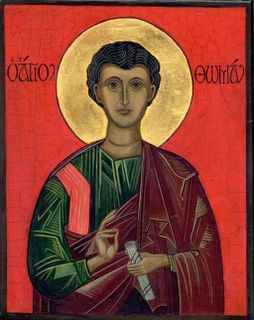
Above is Thomas holding an architect's square.
Friday, June 27, 2008
Jesus [said], "One who seeks will find, and for [one who knocks] it will be opened." (94 Thomas)
What am I seeking?
The first prayer I can remember offering was a request to remain child-like in my engagement with the world.
The words whispered were something like, "Dear God, help me avoid the not-seeing of most grown-ups."
At age nine or ten I perceived that as most moved from childhood they would adopt a predictable set of explanations and expectations.
In effect they would stop seeing, stop seeking, and choose a kind of intellectual and spiritual stasis that seemed to me false and often boring.
I prayed for God's help in seeking the new, surprising, and always changing.
The synoptic parallels are Luke 11:9-13 and Matthew 7:7-11.
Thursday, June 26, 2008
Don't give what is sacred to dogs, for they might throw them upon the manure pile. Don't throw pearls [to] pigs, or they might . . . it [. . .]." (93 Thomas)
They might... what? We cannot be sure. Our sources are insufficient to know.
There is a parallel saying in Matthew's gospel: "Give not that which is holy unto the dogs, neither cast ye your pearls before swine, lest they trample them under their feet, and turn again and rend you." (Matthew 7:6)
It is a teaching in tension with most of what we know Jesus to have offered us.
In Matthew the injunction against dogs and pigs seems to contradict an immediately prior instruction to avoid judging others (see the whole chapter). Without judging how do we know dogs or pigs?
Perhaps the teaching has less to do with what is impure (dogs and pigs) and has more to do with what we define as sacred or holy.
To be sacred - the Hebrew is qodesh - is to be put aside, set apart, and consecrated for special use. It is a common ecclesiastical term having to do with temple rituals.
Is it possible that our typical rush to judgment hears an unintended judgment in the teaching of Jesus? Perhaps Jesus loves the innocence of dogs and pigs. Perhaps Jesus is not warning us about dogs and pigs, but instead is warning us to avoid a tendency to define God as safely separate from most of our living.
But I cannot be sure, my sources are insufficient.
Wednesday, June 25, 2008

Jesus said, "Seek and you will find. In the past, however, I did not tell you the things about which you asked me then. Now I am willing to tell them, but you are not seeking them. (92 Thomas)
In the Gospels of Matthew and Luke - as above -we are assured that if we seek, we shall find.
In the Gospel of Mark we are also assured of finding what we seek. The language is less parallel, but the shared teaching may be more apparent:
Jesus answered them, ‘Have faith in God. Truly I tell you, if you say to this mountain, “Be taken up and thrown into the sea”, and if you do not doubt in your heart, but believe that what you say will come to pass, it will be done for you. So I tell you, whatever you ask for in prayer, believe that you have received it, and it will be yours. (Mark 11:22-24)
Mark tells us that faith in God and lack of doubt are the paths to finding. Thomas adds the precondition of seeking what Jesus has pointed us toward.
Above is an altarpiece giving primary attention to Thomas' discovery of the risen Christ.
Tuesday, June 24, 2008
They said to him, "Tell us who you are so that we may believe in you." He said to them, "You examine the face of heaven and earth, but you have not come to know the one who is in your presence, and you do not know how to examine the present moment." (91 Thomas)
This is my common experience, perhaps our common experience.
We know so much. We can spend our days in detailed examination of great mysteries.
But too often this knowledge and seeking after more knowledge can simply distract me from the present moment and the one in my very presence.
I increasingly perceive that God-is-with-us. The wholeness and fulfillment of God is accessible today, now, in this present moment.
But we must notice. Even more we must choose to be in the moment.
The synoptic parallels are Matthew 16:1-4 and Luke 12:54-56.
Subscribe to:
Posts (Atom)