Monday, April 14, 2008


The disciples said to Jesus, "Tell us what Heaven's kingdom is like." He said to them, It's like a mustard seed, the smallest of all seeds, but when it falls on prepared soil, it produces a large plant and becomes a shelter for birds of the sky. (20Thomas)

The reign of God is less a place and more a process. Rather than a city, a garden, or some similar destination, heaven is a state of becoming.

The reign of God is remarkable for its miniscule beginning. Yet the tiny seed can grow quickly and in one season become a considerable bush.

A state of becoming what? Explicitly, a place of shelter for the vulnerable. Implicitly, a source of many more sharp and spicy seeds.

The synoptic parallels are Mark 4:30-32 and Matthew 13:31-42.

Above is the cross of St. Thomas or sometimes called the Persian Cross.

Sunday, April 13, 2008

Jesus said, "Congratulations to the one who came into being before coming into being. If you become my disciples and pay attention to my sayings, these stones will serve you. For there are five trees in Paradise for you; they do not change, summer or winter, and their leaves do not fall. Whoever knows them will not taste death." (19 Thomas)

Our daily reality consists of ongoing change. Random change. Purposeful change. Change for which we have worked and prayed and change we have resisted and regret.

Each of us change. We age. We learn. Physical, emotional, intellectual, and spiritual change is nearly constant. All is in motion and in flux. This is what we see, hear, touch, taste, and smell.

Yet we also perceive - and often prefer - a sense of continuity. Despite our regular experience of change, it is as if we once encountered the changeless and can not quite give it up.

Saturday, April 12, 2008

The disciples said to Jesus, "Tell us, how will our end come?" Jesus said, "Have you found the beginning, then, that you are looking for the end? You see, the end will be where the beginning is. Congratulations to the one who stands at the beginning: that one will know the end and will not taste death." (18 Thomas)

What should we seek beginning or end? Origin or destiny?

The Jesus of Thomas clearly counsels giving greater attention to the beginning.

If we can find our original purposes and live out those purposes, then we need not be concerned with our ending.

I perceive we originate in God. I seek reconciliation with God.

I seek to close the circle rather than extend the line.

Friday, April 11, 2008


Jesus said, "I will give you what no eye has seen, what no ear has heard, what no hand has touched, what has not arisen in the human heart." (17 Thomas)

We have been given something beyond our wanting, beyond our imagination.

The gift has arrived. It is covered in elaborate historical, cultural, ecclesiastical and theological wrapping.

Some may find the wrapping overdone and even bizarre. But it is, after all, just wrapping.

My grandmother always treated the paper, ribbon and bows with delicate care. Most of the grandkids, me included, would tear past the wrapping as quickly as possible.

But so often what Jesus has given us stays wrapped-up. The gift beyond imagination is left in its box and hidden at the back of the closet.

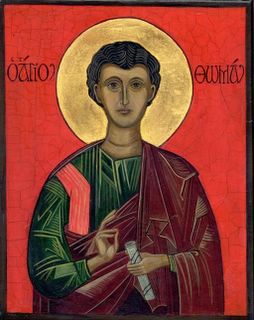
Above is a modern icon of Thomas the Apostle.

Thursday, April 10, 2008

Jesus said, "Perhaps people think that I have come to cast peace upon the world. They do not know that I have come to cast conflicts upon the earth: fire, sword, war. For there will be five in a house: there'll be three against two and two against three, father against son and son against father, and they will stand alone. (16 Thomas)

It is a difficut saying. There are, however, close parallels in all of the synoptic gospels, especially Luke 12.

The saying has certainly proven to be true. Sectarian and religious conflict divides the world. Those with Christian aspirations have wielded fire, sword, and war as much as others.

The synpotic gospels imply this is part of a process by which good and evil are separated. I wonder if it is a way good is tested and even refined.

Conflict - life threatening or not - tends to expose our fundamental character. In the heat of battle can we continue to empathize, extend mercy, even to love our enemy?

Surely we will often fail. But what if we could bring such values even to war? How might that help in winning ultimate peace.

Wednesday, April 9, 2008

Jesus said, "When you see one who was not born of woman, fall on your faces and worship. That one is your Father." (15 Thomas)

It is a curious phrase. Jesus was born of woman and yet is one with the Father. At least this is the orthodox understanding.

How might we recognize one not born of woman? Would the belly-button be missing? Is this the sign that should preoccupy us?

In the book of Job those born of woman are "few of days and full of trouble." (See Job 14) Perhaps it is just a turn-of-phrase for one who is immortal.

In any case, Jesus does not seem to be referring to himself. He is taking his place beside us and joining us in our days and troubles.

Jesus offers his example and his help to escape the trap described by Job and the dead-ends that we make for ourselves.

Tuesday, April 8, 2008


Jesus said to them, "If you fast, you will bring sin upon yourselves, and if you pray, you will be condemned, and if you give to charity, you will harm your spirits. When you go into any region and walk about in the countryside, when people take you in, eat what they serve you and heal the sick among them. After all, what goes into your mouth will not defile you; rather, it's what comes out of your mouth that will defile you." (14 Thomas)

Religious rules can be treacherous. In this verse the fundamental disciplines of fasting, prayer, almsgiving, and diet are simply condemned.

In the gospels of Matthew and Mark the warning is more conditional. There Jesus cautions that pride can pervert the spiritual disciplines. (See Matthew 6)

In recent years I have become increasingly pious. These morning meditations have become the highpoint of many days.

When I travel I seek out shrines and worship services. I read religiously oriented books. I welcome spiritual discussion.

I come from a tradition that mistrusts piety - outward displays of devotion. But - so far - I perceive that this is a journey deeper into uncertainty rather than pride.

The more regular my study and thinking on God, the less sure I am of knowing any two connected things about God.

I am confident that God loves us. I am confident that God is the source of justice. But how God's love and justice interact is - so far -entirely beyond me.

There is an increasing sense that God is entirely beyond me. While I am drawn to God, I am conscious of being at a far edge where I can see very little that I recognize and I mostly feel a combination of thankfulness and humility.

I don't think the rules matter much. But they help begin my day. They bring me comfort. They focus my attention beyond myself.