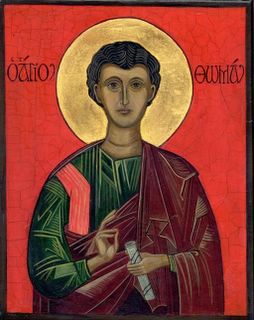
Jesus said to his disciples, "Compare me to something and tell me what I am like." Simon Peter said to him, "You are like a just messenger." Matthew said to him, "You are like a wise philosopher." Thomas said to him, "Teacher, my mouth is utterly unable to say what you are like." Jesus said, "I am not your teacher. Because you have drunk, you have become intoxicated from the bubbling spring that I have tended." And he took him, and withdrew, and spoke three sayings to him. When Thomas came back to his friends they asked him, "What did Jesus say to you?" Thomas said to them, "If I tell you one of the sayings he spoke to me, you will pick up rocks and stone me, and fire will come from the rocks and devour you." (13 Thomas)
Like the eager student in the front row I know the right answer, Jesus is the Son of God redeemer of mankind.
But what does this "right answer" mean?
Too often I treat Jesus as a messenger. He has delivered an interesting policy and strategy report from headquarters. I think about what it might mean for my local plans.
Even more often I treat Jesus as a philosopher. In his words and examples I look for clues to how I might make better, wiser, more successful decisions.
Certainly I treat Jesus as a teacher. I am ready to learn how to better advance my goals and fulfill my needs.
Very seldom do I seriously consider that Jesus is my savior and the savior of the world. Very seldom will I even admit to being lost, much less needing to be saved.
I have a vague recollection of a comedy sketch: A very proper, entirely self-composed, Englishman is slowly sinking into quicksand. A young man comes by and offers a branch by which to pull the man to safety.
"Many thanks," says the man. "But really, I'm quite fine. Not a problem." And so he continues as he sinks lower and lower until we see nothing but the top of his black bowler.
It is hard to save one who will not recognize the danger. May I - may each of us - be sufficiently aware of our urgent need to reach out a hand to our savior.
It is interesting to compare this verse of Thomas to similar exchanges in Mark, Matthew, and Luke.
Monday, April 7, 2008

Sunday, April 6, 2008
The disciples said to Jesus, "We know that you are going to leave us. Who will be our leader?" Jesus said to them, "No matter where you are you are to go to James the Just, for whose sake heaven and earth came into being."(12 Thomas)
For a number of years James was the leader of those who followed Jesus in Jerusalem. It was this James who sat in authority when Paul began his ministry to the Greek-speaking Gentiles.
James, like Jesus and all the apostles, was a Jew who understood Jesus as pointing toward a reform and renewal of the faith received from Abraham and Moses.
James was clearly cautious regarding the potential influence of Greek thought. It was a realistic, even prescient, concern.
The Gospel of John is suffused with Greek philosophical influence. In the late second and early third centuries many of those who moved Christianity into the intellectual mainstream of the Roman Empire did so by adapting and sometimes adopting Greek, especially Platonic, frameworks.
When I perceive a bias against the created world and a preference for an ideal world, or a disdain for the present, or separation of body and spirit I join James in being cautious. We were created for both heaven and earth, future and present, spirit and body.
For a number of years James was the leader of those who followed Jesus in Jerusalem. It was this James who sat in authority when Paul began his ministry to the Greek-speaking Gentiles.
James, like Jesus and all the apostles, was a Jew who understood Jesus as pointing toward a reform and renewal of the faith received from Abraham and Moses.
James was clearly cautious regarding the potential influence of Greek thought. It was a realistic, even prescient, concern.
The Gospel of John is suffused with Greek philosophical influence. In the late second and early third centuries many of those who moved Christianity into the intellectual mainstream of the Roman Empire did so by adapting and sometimes adopting Greek, especially Platonic, frameworks.
When I perceive a bias against the created world and a preference for an ideal world, or a disdain for the present, or separation of body and spirit I join James in being cautious. We were created for both heaven and earth, future and present, spirit and body.
Saturday, April 5, 2008

Jesus said, "This heaven will pass away, and the one above it will pass away. The dead are not alive, and the living will not die. During the days when you ate what is dead, you made it come alive. When you are in the light, what will you do? On the day when you were one, you became two. But when you become two, what will you do?"(11 Thomas)
The one becoming two is often perceived to be a reference to Plato's Symposium and Socrates' description of how the sexes and sexual attraction emerged.
What if, instead, we understood this as referring to our relationshp with God? We were one with God. We have been given a freedom separate from God. We have become as two.
With this freedom, what will we do? Do we seek to further separate ourselves or do we seek reconciliation? What is our choice?
Above is a Greek mosaic of Thomas the Apostle.
Friday, April 4, 2008
Jesus said, "I have cast fire upon the world, and look, I'm guarding it until it blazes." (10 Thomas)
Luke includes a similar - but crucially different - saying, "I came to bring fire to the earth, and how I wish it were already kindled!" (Luke 12: 49).
Forty years ago today Martin Luther King - a spark of divine fire - was assassinated in Memphis. But the fire was not extinguished.
King stood in a great line of fire-keepers, co-custodians of the fire Jesus cast. King received from Gandhi, Gandhi received from Tolstoy, Tolstoy received from William Lloyd Garrison, and so the cleansing flame had been passed from Jesus over many generations.
Each joined Jesus in guarding the fire and sharing it with others. Some of us benefit from the light and warmth of their effort, but do not - yet - join them in guarding and spreading the fire.
Dear God, if it be your will, allow me to receive the fire that Jesus cast. Help me to guard it. Show me where and how it might blaze.
Luke includes a similar - but crucially different - saying, "I came to bring fire to the earth, and how I wish it were already kindled!" (Luke 12: 49).
Forty years ago today Martin Luther King - a spark of divine fire - was assassinated in Memphis. But the fire was not extinguished.
King stood in a great line of fire-keepers, co-custodians of the fire Jesus cast. King received from Gandhi, Gandhi received from Tolstoy, Tolstoy received from William Lloyd Garrison, and so the cleansing flame had been passed from Jesus over many generations.
Each joined Jesus in guarding the fire and sharing it with others. Some of us benefit from the light and warmth of their effort, but do not - yet - join them in guarding and spreading the fire.
Dear God, if it be your will, allow me to receive the fire that Jesus cast. Help me to guard it. Show me where and how it might blaze.
Thursday, April 3, 2008
Jesus said, Look, the sower went out, took a handful (of seeds), and scattered (them). Some fell on the road, and the birds came and gathered them. Others fell on rock, and they didn't take root in the soil and didn't produce heads of grain. Others fell on thorns, and they choked the seeds and worms ate them. And others fell on good soil, and it produced a good crop: it yielded sixty per measure and one hundred twenty per measure. (9 Thomas)
This is one of the most familiar of the parables. Very similar versions are offered in Mark, Matthew and Luke.
The seed is scattered far and wide. The same potential exists with every seed. The potential is amazing.
But a great deal depends on context and readiness. Are we surrounded by thorns? By rocks? Or are we receptive, moist, and fertile?
I have always appreciated the role of the birds. Especially if the seeds lay exposed on rocks or the path, birds are likely to eat them.
In some cases - after the seed has been eaten and the bird has flown far away - the seed may still find its way to fertile soil and achieve its potential.
This is one of the most familiar of the parables. Very similar versions are offered in Mark, Matthew and Luke.
The seed is scattered far and wide. The same potential exists with every seed. The potential is amazing.
But a great deal depends on context and readiness. Are we surrounded by thorns? By rocks? Or are we receptive, moist, and fertile?
I have always appreciated the role of the birds. Especially if the seeds lay exposed on rocks or the path, birds are likely to eat them.
In some cases - after the seed has been eaten and the bird has flown far away - the seed may still find its way to fertile soil and achieve its potential.
Wednesday, April 2, 2008

And he said, The person is like a wise fisherman who cast his net into the sea and drew it up from the sea full of little fish. Among them the wise fisherman discovered a fine large fish. He threw all the little fish back into the sea, and easily chose the large fish. Anyone here with two good ears had better listen! (8 Thomas)
We can busy and bother ourselves with many little things. It is more helpful to focus on a few matters of large import.
The problem can be distinguishing large from small. Different sized fish are easily recognized. The choice is not always so clear.
A large fish feeds more with less effort. How can the goal be achieved more easily? What is the goal?
The wise fisherman discovered not just a large fish, but a fine large fish. Fine for what purpose? What is the quality that matters?
In Matthew's gospel (see Matthew 13:47-48) a similar metaphor is offered. There the goal is more clearly understood as experiencing God's reign.
Jesus said, "The Person is like..." This is an unusual construction which may suggest the fully conscious and actualized human, similar to the Hindu atma.
How do I become the Person that God intends?
Above is a Russian Orthodox icon of St. Thomas the Apostle.
Tuesday, April 1, 2008
Jesus said, "Lucky is the lion that the human will eat, so that the lion becomes human. And foul is the human that the lion will eat, and the lion still will become human."(7 Thomas)
There is no gospel parallel to this saying. It does not remind me of any classical or contemporary aphorism.
Like so many wisdom sayings, and so many of Jesus' parables, it is thought provoking in its ambigutiy. It is a piece of spiritual algebra.
Perhaps... if the lion represents power or passion, when a human consumes the lion's nature then that nature can be subordinated to human moral reasoning. This is a good outcome for all.
But if the lion - power and passion -consumes the human then moral reasoning is lost. When power or passion subordinate moral reasoning, human nature is fouled.
If so, we should not fear the lion. We should, in fact, pursue the lion. But we should take care that in our hunting we do not become the hunted.
There is no gospel parallel to this saying. It does not remind me of any classical or contemporary aphorism.
Like so many wisdom sayings, and so many of Jesus' parables, it is thought provoking in its ambigutiy. It is a piece of spiritual algebra.
Perhaps... if the lion represents power or passion, when a human consumes the lion's nature then that nature can be subordinated to human moral reasoning. This is a good outcome for all.
But if the lion - power and passion -consumes the human then moral reasoning is lost. When power or passion subordinate moral reasoning, human nature is fouled.
If so, we should not fear the lion. We should, in fact, pursue the lion. But we should take care that in our hunting we do not become the hunted.
Subscribe to:
Posts (Atom)